
I live in Lower West Pubnico, Nova Scotia.
Population: small. Coastline: stunning. Distance from Silicon Valley: about as far as you can get.
But right here in Nova Scotia, something remarkable is happening with artificial intelligence.
Not the usual AI hype coming out of Toronto or San Francisco. Real, practical innovation is taking shape on the ground here. As a solopreneur who uses AI every day to run a one-person business, I’ve been paying close attention.
What I’m seeing matters beyond Nova Scotia. This province is quietly building frameworks and approaches the rest of Canada will likely adopt later.
1. We’re Governing AI Without a Federal Law — And Doing It Well
Canada doesn’t have a federal AI law yet. The proposed Artificial Intelligence and Data Act (AIDA) died when Parliament prorogued in January 2025.
While Ottawa sorted itself out, Nova Scotia chose not to wait. The province leaned on its own Digital Code of Practice. A structured framework requiring public technology to be impactful, equitable, and secure by design.
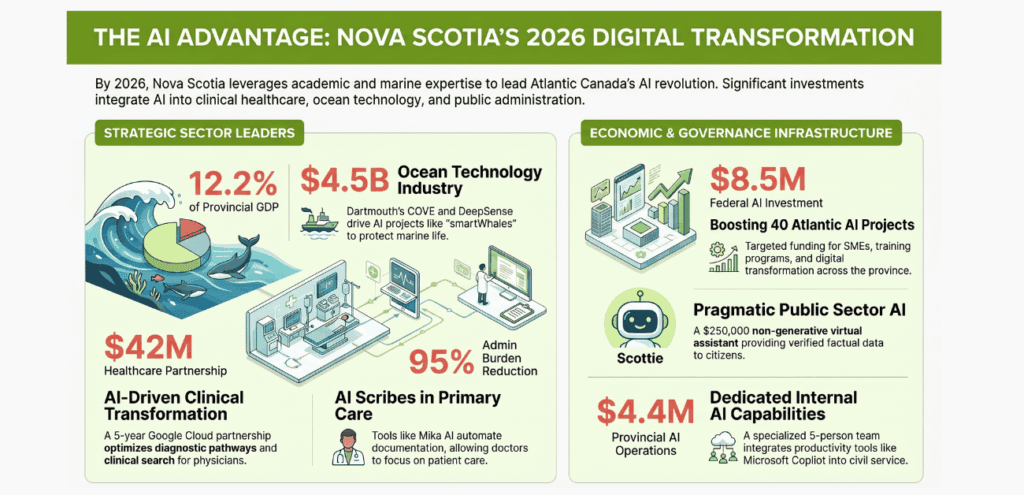
They put this philosophy into action by launching “Scottie”—a public-facing AI chatbot. What makes Scottie fascinating is a deliberate values decision: it is strictly non-generative. To prevent hallucinations, it only pulls pre-verified facts from public government directories.
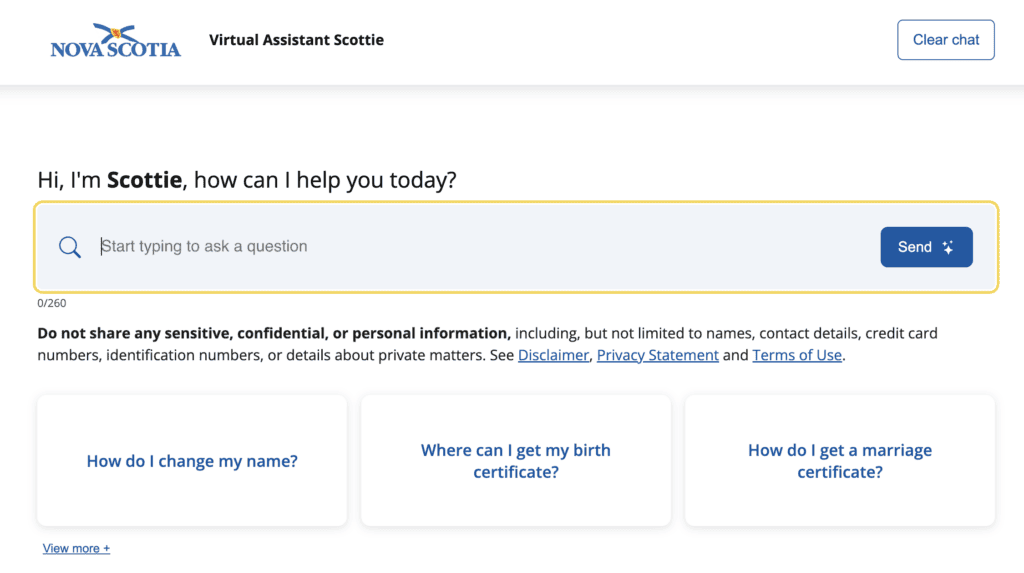
By making these design choices locally, Nova Scotia’s public sector is quietly writing the micro-governance blueprints that federal legislation will likely mirror someday. We are the lab.
2. Privacy Isn’t an Afterthought Here — It’s Baked In
Most AI applications send your data away to massive centralized servers, leaving you to wonder who actually sees it.
Halifax startupBegin AI, backed by Sandpiper Ventures, is building something entirely different. Their approach relies on edge computing, meaning the machine learning happens directly on your device. Your data never leaves your phone, eliminating the need for a centralized cloud.
They built this model from the ground up to meet Canada’s strict PIPEDA privacy laws. For everyday users, it proves a vital point: the “privacy vs. progress” argument is a false dichotomy. You can have powerful AI without compromising your data.
3. Making AI Green and Equitable
Running large AI models costs massive amounts of energy. While global AI tech giants focus purely on capability, Dalhousie University’s RAISE Lab, led by Dr. Masud Rahman, is focused on Green AI.
The lab studies the energy efficiency of deep learning software and develops optimization tools like CodeGreen to reduce the computational cost of running AI models. This work matters for two reasons:
- The Planet: AI’s skyrocketing energy consumption makes sustainable machine learning an environmental necessity.
- Equity: Leaner, cheaper AI models lower the barrier to entry for small businesses and solopreneurs who can’t afford enterprise-grade infrastructure.
What This Means for You
The global conversation about AI is rapidly moving past “which tool should I use?” and turning toward deeper questions: What kind of AI do we want to build? How do we protect people? How do we power it responsibly?
Nova Scotia is actively driving that conversation.
If you’ve been quietly skeptical about the rise of AI, knowing that responsible, privacy-first, sustainable technology is being engineered right here in Atlantic Canada might help ease your mind. You aren’t just adopting reckless tech from a distant corporation; you are part of a province that is defining what the future looks like.
And that is something to be proud of.
Sources: Nova Scotia Digital Code of Practice; CBC News — NS AI Government Team; Canada Health Infoway AI Scribe Pilot; Dalhousie University RAISE Lab; Ontario Bar Association — Top Five AI Trends Shaping Canada’s Legal Landscape in 2026; Sandpiper Ventures / Begin AI; Betakit — $8.5M ACOA Atlantic AI Investment.